
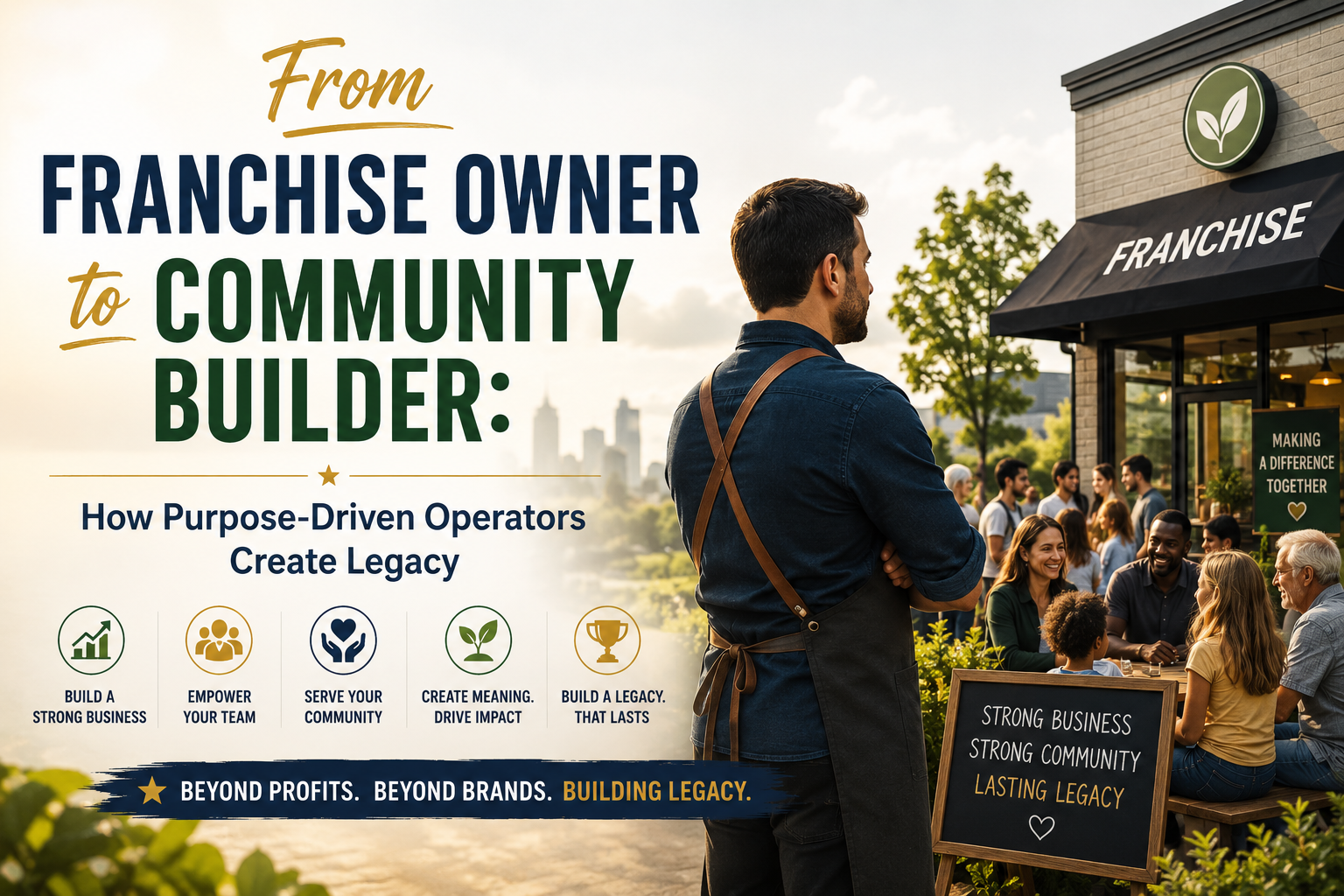
The best franchise owners do not simply operate a unit. They build a presence.
They become known. They become trusted. They become part of the community’s rhythm. Parents recognize them. Schools refer to them. Local organizations partner with them. Families begin to see their business not as another storefront, but as a place that reflects the community’s values.
That is the difference between being a franchise owner and being a community builder.
In purpose-driven franchising, this distinction matters. A traditional operator may focus primarily on staffing, revenue, local marketing, and day-to-day execution. Those things are still essential. But a purpose-driven operator adds another layer: mission. They understand that the business exists to create impact, not just income. They see every class, appointment, session, event, membership, and customer interaction as part of a larger story.
That larger story is legacy.
For many entrepreneurs, especially those considering franchise ownership in 2026, legacy has become a major driver. They are not only looking for financial return. They are looking for a return on energy, time, values, and identity. They want to know that the work they do every day is building something meaningful.
This aligns with a larger generational shift. Junior Achievement research found that 75% of teens would consider becoming entrepreneurs and 58% would be likely to start a business that addresses a societal need, even if it meant making less money. Source: Junior Achievement USA / EY Teen Entrepreneurship Survey That matters because today’s young people are tomorrow’s entrepreneurs, employees, customers, and community leaders. They are watching what business represents.
Purpose-driven franchise owners can become living examples of business as a force for good.
In a youth development franchise, that example becomes even more powerful. A child may come in for tutoring and leave with confidence. A young athlete may come in to train and leave with discipline. A student may join a chess program and discover patience, strategy, and focus. A child with sensory needs may enter an inclusive gym and feel, perhaps for the first time, that the world has a place designed for them.
Those moments are not small. They are the foundation of community impact.
A purpose-driven operator understands that local reputation is not built through advertising alone. It is built through consistency. It is built by showing up at school events, supporting local causes, forming partnerships, hiring people who believe in the mission, and communicating with families in a way that feels personal and sincere. It is built by doing the right thing long enough that the community begins to trust the brand without needing to be convinced.
That kind of trust becomes a business advantage.
Edelman’s brand trust research found that people continue to place significant trust in brands they personally use, especially when those brands help them feel calm, confident, inspired, and supported. Source: Edelman 2025 Brand Trust Special Report For a local franchise owner, this is incredibly important. Trust is not abstract. It is experienced in the lobby, on the phone, during a child’s first session, in the follow-up email, in the way staff members greet families, and in how problems are handled.
Every touchpoint either strengthens the mission or weakens it.
That is why franchisors must recruit and support purpose-driven operators intentionally. The right franchisee is not just someone who can afford the investment. The right franchisee is someone who can carry the mission. They need leadership ability, emotional intelligence, community awareness, and the humility to follow systems while still bringing local passion to the brand.
Purpose-driven franchisors should ask deeper questions during the candidate process. Why does this mission matter to you? How do you want to impact your community? What kind of legacy are you trying to build? How will you lead a team around values, not just tasks? How will you represent the brand when no one from corporate is watching?
These questions reveal alignment.
For franchisees, the same principle applies in reverse. They should evaluate franchise opportunities not only by cost, territory, unit economics, and support, but also by mission fit. Does the brand reflect what they believe in? Is the culture real? Does leadership live the values? Are franchisees supported as community leaders or merely managed as operators?
When the alignment is strong, the work becomes more powerful.
A purpose-driven franchise owner can create jobs, serve families, mentor young people, support schools, create belonging, and become a local example of entrepreneurship with meaning. Over time, that owner may build more than a successful business. They may build a name people associate with trust, service, and impact.
That is legacy.
At Americas Franchising Group, we believe franchising is one of the most practical pathways to purpose-driven entrepreneurship because it gives owners the structure of a proven system while allowing them to create meaningful local change. The model matters. The brand matters. The support matters. But ultimately, the local owner brings the mission to life.
A franchise location can generate revenue.
A purpose-driven franchise owner can change a community.
And when the right owner meets the right mission, the result is more than business ownership.
It is legacy building.